
IFFEd is powerful financing engine for global education that multiplies donor resources seven-fold by unlocking additional financing from the multilateral development banks (MDBs); this financing enables governments to invest in evidenced based education and skills reforms in lower-middle-income countries.
IFFEd is designed to supercharge education financing and help tackle the annual $71bn education financing gap. At the core of its model is a bold and innovative guarantee instrument designed to unlock billions in education financing. It provides a new, affordable stream of finance that will result in millions more young people going to school and acquiring the knowledge and skills they need to learn, earn, and thrive.

How we unlock financing
IFFEd is an innovative financing structure that takes advantage of the multilateral development bank’s capacity to leverage financing for education and skills development in lower-middle-income countries. The IFFEd model takes contributions from a range of partners which is then used to create a dedicated pool of concessional capital for education. This pool of financing is more affordable for lower-middle income countries than existing multilateral development bank or commercial financing.
Many countries are eager to develop and improve their education systems but just don’t have the budgets to do so. Lower-middle-income countries can afford to borrow for education, but not at commercial rates. IFFEd is designed to address this critical need. By maximising scarce donor resources in an unprecedented way, IFFEd allows donors to better meet the financing needs of lower-middle-income countries without having to reduce allocations elsewhere, either for low-income countries or for humanitarian crises.
The financing challenge
Multilateral development banks can borrow in capital markets and provide financing equal to several times their paid-in capital while retaining their powerful credit ratings. However, even with their ability to leverage large sums of capital, the multilateral development banks have two substantive challenges when it comes to education and skills financing: insufficient capital and low demand. IFFEd was designed to help tackle both:
Global challenge
Insufficient capital

The multilateral development banks have insufficient capital available to meet the sustainable development goals, including SDG4 – equal access to education for all.
IFFEd solution
IFFEd acts as an insurer for the multilateral development banks.
Using its guarantees, IFFEd essentially insures the multilateral development banks’ loan portfolios to generate additional financing capacity.

IFFEd’s, so called, portfolio insurance acts as a tool for the multilateral development banks to generate additional lending capacity. IFFEd does not guarantee individual education loans but provides loss insurance across the whole lending portfolio of a multilateral development bank. This enables multilateral development banks to borrow funds on capital markets – obtaining a rate of leverage several times the value of the insurance amount – and offering these funds in the form of new education loans. To ensure that this additional capacity is used for education, IFFEd only issues the insurance when the MDB makes an additional loan in support of education.
Global challenge
Low demand
There is lower demand for non-concessional financing for education and skills from national Governments. As countries grow and transition from concessional lending to non-concessional financing, they are often reluctant to borrow for education with multilateral development bank interest rates, especially as the returns to education only appear over the longer term.
IFFEd solution
IFFEd offsets borrowing costs.
IFFEd incentivises lower-middle-income-countries to seek financing for education by providing a share of the financing as a grant, which achieves lower interest rates.

IFFEd helps reduce the effective price of education financing by blending grants with loans (generating a lower effective interest rate), incentivizing lower-middle-income countries to borrow for education. A borrowing country will sign a package agreement with a Multilateral development bank, which would include both the loan agreement and an accompanying grant agreement.
The financing components
IFFEd uses donor guarantees to provide a new form of portfolio guarantee to MDBs. This allows them to raise additional financing in capital markets and provide funding to countries for education. For every $1 in guarantees, donors only need to provide $0.15 in cash as paid-in capital, with the remaining $0.85 in the form of a low-risk guarantee commitment to disburse should countries in the multilateral development bank portfolio default. For every $1 of the portfolio guarantee provided through IFFEd, MDBs are able to provide an additional $4 in financing to LMICs.This means $0.15 paid-in capital triggers $4 in MDB lending – a 27x leverage. Just $40 million in paid-in capital + $100 million in grants mobilizes $1 billion in concessional education and skills financing.
IFFEd’s guarantees from donors (unlike traditional multilateral development bank callable capital) has been accounted for by Moody’s as “useable equity.” Backed by its innovative contingent capital, IFFEd is 5x more efficient than the conventional MDB model in leveraging paid-in capital to support loans.
Donors also provide grants to IFFEd. These grants are disbursed alongside the loans to effectively buy down the interest rates charged by the MDBs and lower the cost of education financing for eligible countries. These grants allow countries to borrow for education on more affordable terms and encourage them to invest in education. For every $1 billion in MDB financing, we propose $100 million in grants to soften the terms of the financing provided.
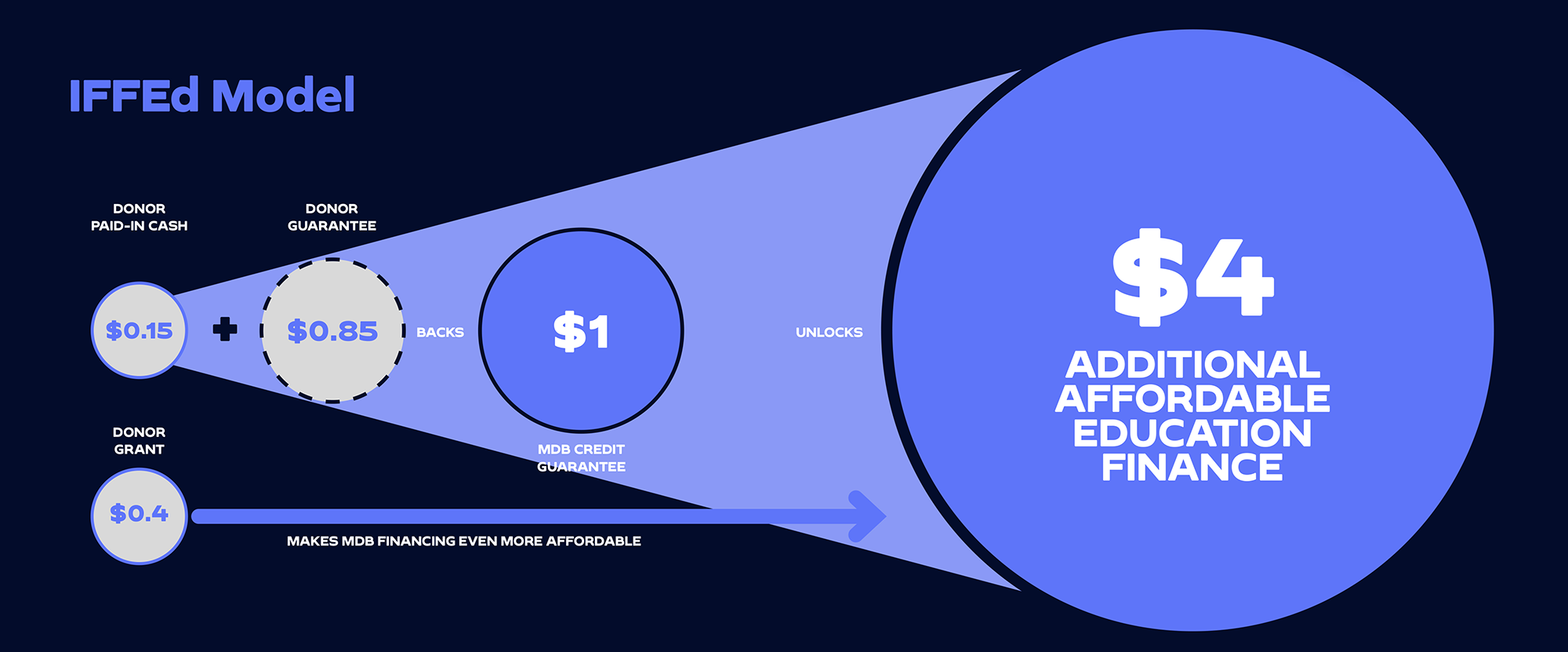
IFFEd is a game-changer that can multiply scarce donor cash resources seven fold. It harnesses the power of the existing multilateral development banks (MDBs), such as the World Bank and the Asian Development Bank and does not create new parallel structures. This innovative way of working will allow IFFEd to unlock billions in new education financing.