
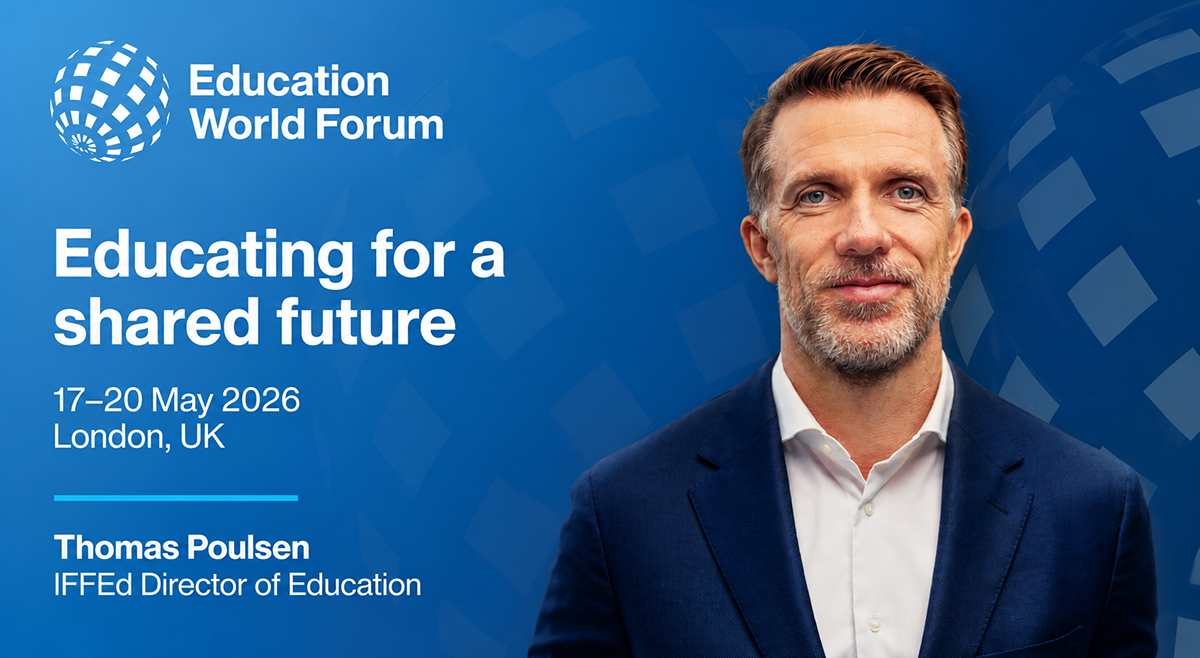
IFFEd is delighted to announce the appointment of Thomas Poulsen, who joins IFFEd as its inaugural Director of Education.
Thomas joins from The Norwegian Agency for Development Cooperation (Norad) where he lead global agency education, and prior to that served in senior roles at the World Bank across Asia, Africa and the Pacific.
To mark his appointment, Thomas reflects on the work ahead and how: “financing is the mechanism; learning is the goal”
Smarter financing for the outcomes that matter most
More financing for education in the most marginalised countries is essential — but not sufficient. I have spent two decades working across Sub-Saharan Africa, South and Southeast Asia, and the Pacific. Across those contexts, the pattern is consistent: too many children are in school without learning; too much money is spent without reaching them; too many young people leave education without the skills to find and hold employment. The research on what works — and what matters — is robust and growing. The challenge is connecting financing to actual results. That connection is what the International Finance Facility for Education (IFFEd) is built to make.
Learning — the purpose behind the financing
Financing is the mechanism. Learning is the goal. At the heart of IFFEd’s work is a straightforward ambition: that children in the most marginalised countries access an education that gives them the foundations to thrive — the literacy, numeracy, and skills to participate in society and the economy. SDG4 sets that ambition collectively. The question is how to make it a reality where the gap between aspiration and reality is widest.
It is a question to which I have pursued the answer across emergency response in East Africa, in program design and policy work at the World Bank, and in contributing to the global financing and education architecture for a bilateral donor. It is a question that runs across the full education lifecycle, from early childhood through to technical and vocational training, and so has my work. The jobs agenda is not a separate conversation — it is the destination that gives the rest of it meaning. At every level, from the classroom to policy, in fragile states and in lower-middle-income economies (LMICs) navigating rapid economic change, the question is the same: are we building systems that deliver the skills people need to participate and prosper in the 21st century?
IFFEd’s entry point
The global education financing architecture has strong institutions in complementary roles. IFFEd’s entry point is specific and different, and it is the one I find most compelling. More than half of the world’s youth live in LMICs. These countries are increasingly too “wealthy” for sizeable grant opportunities yet face real constraints in financing or borrowing affordably for education. Without investments now, the challenge doesn’t just persist — it compounds, leaving an entire generation without the foundation they need to thrive. Throughout my career I have worked on designing large-scale programmes where standard financing pathways fell short, developing innovative instruments that linked increased fiscal space directly to education investment, and engaging governments and multilateral partners to build the coalitions needed to make reform stick.
By working through the Multilateral Development Banks (MDBs) expanding lending capacity and blending grants to reduce borrowing costs, IFFEd makes education financing viable where it is increasingly difficult. By engaging early in project design, IFFEd ensures that financing translates into stronger education systems and better learning outcomes.
Agile, focused, and collaborative
IFFEd is deliberately designed to be an efficient and nimble organisation, one that strengthens LMIC governments and supports MDBs rather than building parallel systems or replicating existing expertise. I have worked in and around institutions of many sizes and what I have learned across those contexts is that the most effective organisations are not necessarily the largest – they are the ones that read where leverage sits and move quickly and strategically when opportunity arise. That approach is precisely what IFFEd’s model is built around. Where gaps in capacity or capability to deliver better learning and earning outcomes exist, IFFEd determines the most appropriate way to address them. The lean and agile model is what makes IFFEd different: speed, focus, and a low bureaucratic footprint — the ability to engage directly where it matters, without the weight of its own complexity.
The focus is consistent and uncompromising: financing what matters most, reaching the children in greatest need, and improving what they learn. At Norad, I led the strategic sharpening of Norway’s global education engagement by building a framework and portfolio that brought coherence and demonstrated that spending efficiency and learning outcomes are not separate considerations. They are the same challenge.
IFFEd’s approach is not about doing more of what already exists. The problems in education are well understood. I led the World Bank’s Education Finance Watch in 2022 and 2023 and the gaps it documents are not a mystery. What is lacking is perhaps the willingness to tackle them differently. IFFEd is built around precisely that kind of innovation – finding smarter, more targeted ways to drive change and outcomes at scale.
A dual multiplier
This is what makes IFFEd distinctive: it is designed to operate as a dual multiplier, on financial innovation and on education impact simultaneously. Increasing the availability of affordable financing is necessary but not the end goal. Financing must be structured around measurable, improved education outcomes, tackling the learning and jobs crisis at its root and supporting countries to develop the skills they need to prosper. I have tried to hold both sides of that equation together throughout my career — whether leading large-scale multi-donor education programmes at the World Bank, developing innovative debt financing instruments with partners, shaping Norway’s global education strategy at Norad, or co-founding venture capital investment vehicles in Southeast Asia. The lesson across all of it is the same: scale of financing matters, but only if structure and intent are right from the start.
This dual mandate is embedded in how IFFEd works at every stage: project design adapted to each national context; proven, evidence-based interventions and policy support; implementation by governments and local systems at scale; tracking progress; and active policy influence to amplify the impact of education and skills investments.
Drawing on what has worked and what needs to be improved, I am looking forward to unlocking the learning and earning multipliers at scale – driving country-led impact to achieve learning at scale across the full education lifecycle.
18 May 2026
News

Ukraine’s former First Deputy Minister for Education and Science joins IFFEd
Ukraine’s former First Deputy Minister of Education and…

Education sector has good components, but bad plumbing
IFFEd is delighted to announce the appointment of…

Supporting an Indian state government to achieve its economic aspirations
The Asian Development Bank (ADB) and IFFEd have…