
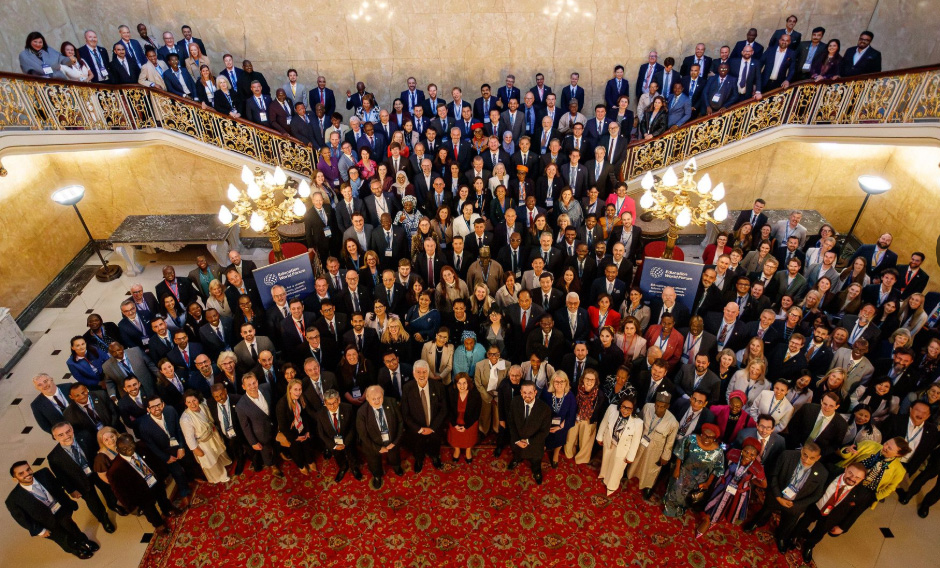
As ministerial delegations, donors and partners return home following the Education World Forum in London IFFEd’s CEO, Karthik Krishnan, reflects how successful reform can only be driven if aligned with national priorities.
Around the world, there is remarkable alignment on the importance of education; this is despite the drastic reduction in ODA. From the recent G7 discussions on human capital and digital transformation to the World Bank and IMF Spring Meetings’ emphasis on jobs, resilience, and inclusive growth, global leaders increasingly recognize that education and skills are the foundation for economic opportunity, climate, health and social equality.
But, Global ambition without coordinated action is likely to unlock human potential and propel countries to prosperity.
The defining challenge for this generation is not whether we know what to do. It is whether countries have the local capacity, financing, and flexibility to translate global priorities into measurable outcomes for children and young people. Education oftens takes a backseat in the long list of immediate priorities because it is a crisis that runs low on the radar until it explodes. Education reform succeeds not because it is announced in global forums, but because State and national Governments are able to – and are incentivised to – prioritize it, and because it is actively owned by governments, implemented by teachers, and trusted by communities.
That is why the future of education finance and delivery must begin with a simple principle: global priorities require local buy-in and local capability. This has been the cornerstone of many conversations at the Education World Forum (EWF) where Ministers and their delegations gathered last month with policy makers and financiers.
For too long, education reform has been approached through fragmented projects and constrained by the realities of short political cycles. Yet the countries making the strongest progress are those building durable national systems — systems shaped by local realities, driven by domestic leadership, and financed with long-term confidence.
Three core barriers continue to drive chronic underinvestment in education.
- Narrative barrier: Education lacks the same sense of urgency or “burning platform” that mobilizes action in sectors such as health or climate. The consequences of underinvestment often emerge decades later, making them politically and financially easier to defer.
- Technical barrier: Measuring educational outcomes remains inconsistent and difficult, while the ecosystem itself is highly fragmented and deeply localized. This makes it challenging to compare impact, scale what works, and attract sustained investment.
- Structural barrier: Political and financial systems are poorly aligned with education timelines. Meaningful education reform requires long horizons, yet electoral cycles, investor expectations, and funding structures tend to prioritize short-term results and lower-risk opportunities.
Addressing these barriers will require a fundamental shift in how education is understood, measured, and financed. This includes reframing education not as a cost center, but as a catalytic investment in human capital and economic resilience; moving from input-based metrics toward outcomes and equity-adjusted returns; and evolving financing models beyond traditional grants toward blended, pooled, and outcome-linked instruments capable of supporting long-term system transformation.
At the Spring Meetings this year, leaders repeatedly returned to the importance of strengthening institutions, mobilizing domestic capacity, and connecting investment to tangible outcomes. That message matters enormously for education. Sustainable progress will not come from importing models from elsewhere. It will come from empowering governments to build systems that work in their own contexts.
This means supporting ministries of education not only with financing, but also with the ability to plan, adapt, and innovate. It means enabling countries to lead their own reforms while ensuring accountability for results. And it means recognizing that resilience – whether against climate shocks, conflict, or economic disruption, depends on strong local systems that can continue delivering learning even during crisis.
4 June 2026
News

Ukraine’s former First Deputy Minister for Education and Science joins IFFEd
Ukraine’s former First Deputy Minister of Education and…

Education sector has good components, but bad plumbing
IFFEd is delighted to announce the appointment of…

Supporting an Indian state government to achieve its economic aspirations
The Asian Development Bank (ADB) and IFFEd have…